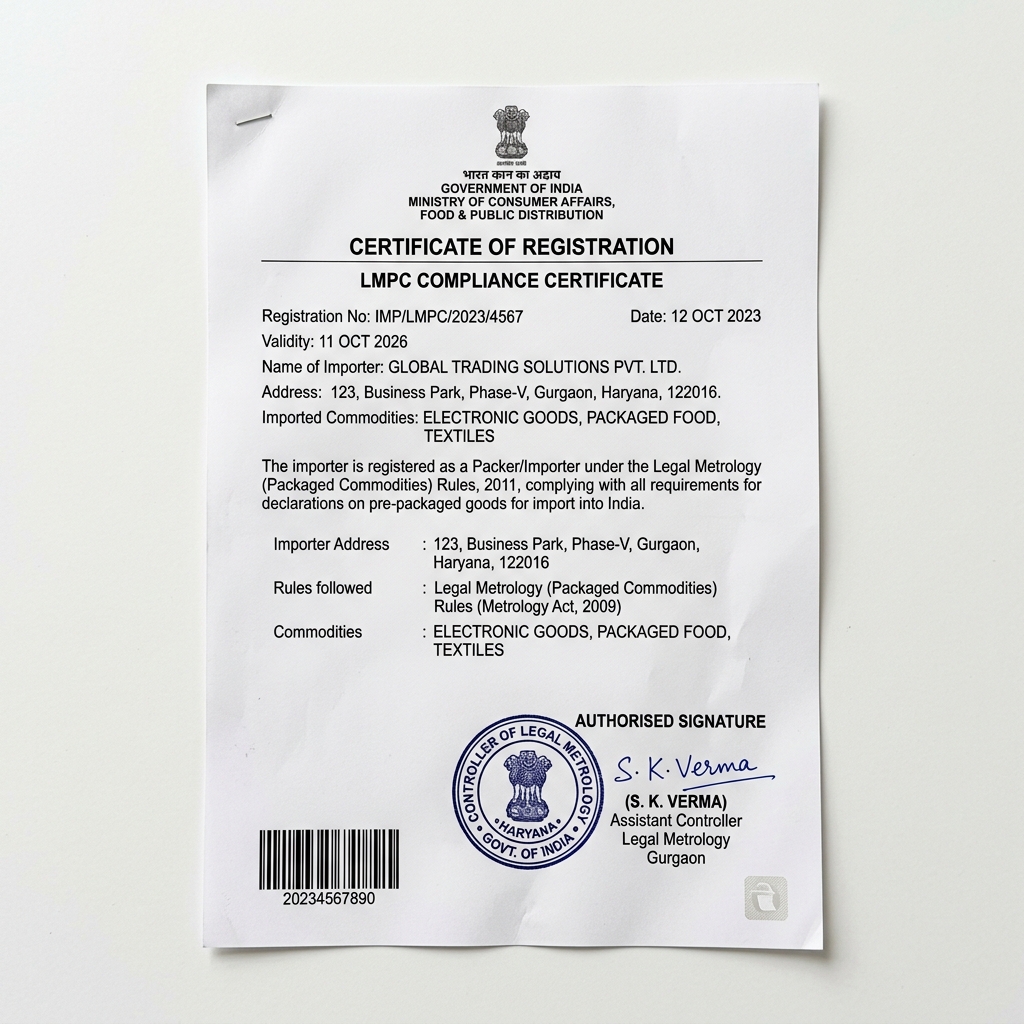
LMPC — Legal Metrology Packaged Commodities — is a registration that every importer of pre-packaged goods must obtain before their products can legally enter the Indian market. It comes under Rule 27 of the Legal Metrology (Packaged Commodities) Rules, 2011. Customs specifically checks for this. If you don't have it, your shipment stays at the port.
We provide end-to-end compliance for both Legal Metrology and Extended Producer Responsibility (EPR). Get a combo package for faster clearance and seamless import operations.
LMPC — Legal Metrology Packaged Commodities — is a registration that every importer of pre-packaged goods must obtain before their products can legally enter the Indian market. It comes under Rule 27 of the Legal Metrology (Packaged Commodities) Rules, 2011, backed by the Legal Metrology Act, 2009.
People in the trade call it the LMPC Import License or simply the LMPC Certificate. But whatever you call it, the purpose is the same — making sure that goods imported for sale in India carry the right information on their packaging. MRP, quantity, country of origin, expiry date — all of this has to be clearly mentioned, and the certificate is what proves you're doing it right.
Customs authorities specifically check for this. If you're importing packaged goods and don't have it, your shipment stays at the port.
The rules require anyone who manufactures, packs, or imports a pre-packed product for sale in India to display specific details on the packaging:
There's no flexibility here. Either the label has all of it, or it doesn't comply.
"We were stuck at customs for 15 days because we didn't know about LMPC. InteLegal stepped in, reviewed our labels, filed the application, and got our certificate super fast."
The Rules leave very little room for interpretation. Registration has to be done within 90 days of starting import or pre-packaging activity.
| Entity Type | What's Required |
|---|---|
| Importers of Pre-Packaged Goods | Must register before customs clearance — no exceptions |
| Manufacturers / Producers | Registration needed before goods go to market |
| Packers / Re-packers | Required before retail distribution |
| E-commerce Sellers | Applicable for all packaged consumer goods sold online |
| FMCG Brands | Full compliance is mandatory |
| Pharma & Medical Distributors | Required under the Act |
| Electronics & Appliance Importers | Needed before import clearance |
| Wholesale / Distribution Businesses | Must register to supply retailers |
There isn't just one type. What you need depends on where your business sits in the chain. If you import and repack, you need two certificates.
For any business bringing pre-packaged goods into India for sale or distribution. Required before customs clearance — no exceptions.
If you're making something, packaging it under your own brand, and putting it in the market.
Businesses that buy goods in bulk and repack them into smaller units before selling need a separate registration.
If you take an already-packaged product and put a new label on it (brand name, different MRP, translated text), it counts as re-labelling.
Online sellers must comply. If you sell pre-packaged goods through any digital marketplace, LMPC rules apply the same way.
"InteLegal handles all our LMPC compliance. They don't just file forms; they actually told us what changes to make on our MRP stickers to avoid future fines. Highly recommend their auditing service."
What you need to submit can vary depending on the entity type and state. We prepare and verify all of these — you provide the originals.
Proof that your business is legally registered.
Mandatory for importers — issued by DGFT.
Rental Agreement or Ownership Proof for your premises.
Required if it's a partnership firm or LLP.
If you have a registered brand or monogram, attach it.
Mandatory for food and beverage products.
Must show MRP, net quantity, origin, and dates.
Aadhar + PAN of whoever signs the application.
The Central Government-issued Importer Registration Certificate is valid for the lifetime of the product or business it was issued for. You don't need to keep renewing it.
State-issued certificates — typically those for packers and manufacturers — come with a fixed validity, generally anywhere from 1 to 5 years depending on the state. These need to be renewed before they lapse.
Even a short gap in validity can trigger legal trouble. We track renewal dates and alert you 60 days in advance.
A wide range. If your product is packaged, has a fixed quantity, and is sold to end consumers — LMPC almost certainly applies.
We've been handling LMPC registrations across various product categories. We know exactly where applications get held up.
We look at your specific business and tell you which registration you actually need.
We review your labels before submitting the application, so compliance issues are caught early.
We file with the right authority — Central or State — depending on your situation.
We prepare and submit the complete application correctly the first time.
We handle renewals and send reminders in advance so nothing lapses.
We conduct compliance audits to check whether your packaging setup has exposure to fines.
Yes. There's no threshold or exemption for smaller shipments. If you're importing pre-packaged goods into India for commercial purposes, the registration is required before customs clearance.
If you're doing both — importing goods and then repacking or re-labelling them under your brand — yes, you need two. One for import, one for packing. If you're only importing and selling as-is, one is enough.
They won't clear customs. You'll also be looking at potential penalties and detention costs. The sooner you start the registration process, the better — but there's no retroactive way around the customs hold.
For the Central Government-issued certificate, yes — it's valid for the lifetime of the business or product. State-level packer and manufacturer certificates have a fixed term and do need to be renewed.
Typically 7 to 25 working days. Depends on the product category, the state, and how clean your documentation is. Delays usually happen when labels aren't compliant or when the department asks follow-up questions.
Yes. Selling through Amazon, Flipkart, Meesho, or any other platform doesn't exempt you from these rules. If the goods are pre-packaged and sold to consumers, LMPC applies — online or offline.